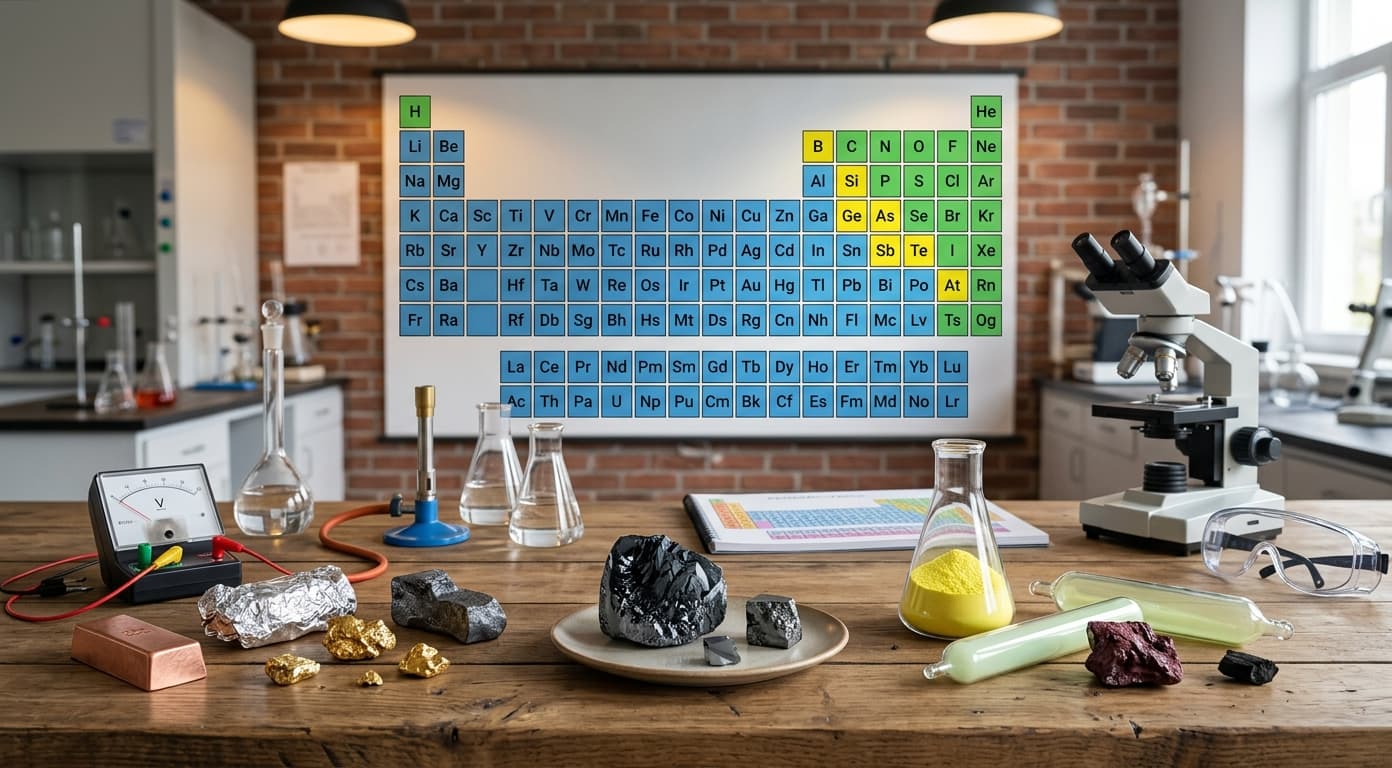
Chemistry can feel confusing when the periodic table looks like a maze of symbols. Gamma helps students organize complex chemistry concepts into clear visual notes. However, understanding the table starts with recognizing its basic categories.
Why the Periodic Table Feels Difficult
The periodic table contains many elements with different properties. Therefore, memorizing every element can quickly overwhelm students. Students often struggle to identify elements that behave similarly. They may also confuse metals, nonmetals, and metalloids during tests. Fortunately, you can simplify this process by learning patterns instead of isolated facts. The table becomes easier once you understand each category's location.
Understanding Metals, Nonmetals, and Metalloids
What Are Metals?
Metals occupy most of the periodic table. They generally appear across the left and center portions. Most metals conduct heat and electricity effectively. Additionally, many metals look shiny and remain solid at room temperature. Iron, copper, aluminum, and gold provide familiar examples. These elements also support construction, electronics, transportation, and manufacturing. When studying metals, nonmetals, and metalloids, focus on location first. The position provides an immediate visual clue about an element's classification.
What Are Nonmetals?
Nonmetals generally appear on the right side of the periodic table. However, hydrogen belongs to this category despite appearing on the left. Nonmetals usually conduct electricity poorly. Many also lack the shiny appearance commonly associated with metals. Oxygen, nitrogen, sulfur, and chlorine represent common nonmetals. These elements support important biological, industrial, and environmental processes.
What Are Metalloids?
Metalloids sit between metals and nonmetals. They commonly appear along the table's zigzag boundary. These elements demonstrate properties associated with both major categories. For example, silicon conducts electricity under certain conditions. Boron, silicon, germanium, arsenic, antimony, and tellurium commonly classify as metalloids. Therefore, learning the boundary makes classification much easier. Instead of memorizing each element, recognize the visual pattern.
A Simple Way to Read the Table
Start With the Location
First, identify the element's position. Elements on the left usually belong to the metals category. Next, check the right side. Most elements there represent nonmetals. Finally, look near the staircase-shaped boundary. Those elements often represent metalloids. This approach makes metals, nonmetals, and metalloids on the periodic table easier to recognize.
Compare Their Properties
After identifying the location, compare physical and chemical properties. This step reinforces each classification. Metals generally conduct electricity and heat well. Meanwhile, nonmetals usually show weaker conductivity. Metalloids occupy the middle ground. Their conductivity can vary with temperature and other conditions. You can also compare appearance, state, malleability, and chemical behavior. These differences create useful memory cues.
Use Visual Organization to Study Faster
Chemistry becomes easier when you organize information visually. Instead of reading long paragraphs, create sections for each category. For example, create one section for metals and another for nonmetals. Then place metalloids between them as a transition category. You can include examples, properties, locations, and practical uses under each section. Consequently, you create a compact study resource. At this stage, Gamma provides a practical way to organize scattered chemistry notes. Students can structure comparisons, summaries, and key concepts without creating everything manually.
What About Other Classification Problems?
Students often study chemistry alongside unrelated classification topics. For instance, you may encounter types of parties in social studies or event planning. Although these subjects differ, both topics involve grouping information logically. Classification helps people understand complex information through meaningful similarities. The same strategy works with chemistry. Group elements according to shared properties, then compare differences within each category. This method reduces memorization pressure. More importantly, it encourages you to understand why elements belong to specific groups.
Build a Better Study Routine
Create Comparison Charts
Start with a simple comparison chart. Include category, location, conductivity, appearance, and examples. Then add one or two practical uses for each category. These details can make abstract chemistry concepts easier to remember.
Practice With Random Elements
Next, test yourself using random element names. Identify their category without checking the table immediately. After answering, verify your result. If you make a mistake, review the element's location and properties. Repeated practice strengthens recognition. Eventually, you will identify categories more naturally.
Explain Concepts in Your Own Words
Finally, explain each category without reading your notes. Teaching a concept forces you to organize information clearly. For example, explain why silicon differs from typical metals. Then describe why it differs from most nonmetals. This technique exposes knowledge gaps quickly. Therefore, you can focus revision on areas that need improvement.
Make Chemistry Notes Easier to Manage
A well-organized study system can save significant time. Instead of keeping scattered notes, combine related information into one visual resource. You can include diagrams, comparisons, examples, and short explanations. This format also makes revision easier before quizzes and examinations. Furthermore, visual organization helps you recognize relationships between concepts. That benefit becomes especially useful when studying several chemistry chapters together. With Gamma, you can turn complex material into organized presentations and study resources. The goal isn't to replace learning, but to make information easier to navigate.
Conclusion
Understanding the periodic table for metals, nonmetals, and metalloids becomes easier when you focus on patterns. Start with location, compare properties, and practice classification regularly. You can also organize examples and comparisons into simple visual study materials. This approach reduces confusion while making revision more efficient. Ultimately, Gamma supports a clearer learning workflow by helping you structure complex chemistry information. Use better organization to study smarter and approach the periodic table confidently.